What are the five most common roofing problems in Shady Shores?
Most roof trouble starts as a small, quiet defect, so knowing what to look for gives you time to plan and budget.
What are the five most common roofing problems?
The five most common roofing problems are worn shingles that shed granules, hail and wind damage, failed flashing, cracked pipe boots, and poor attic ventilation. Most start small and stay hidden for months. Catching them early lets you budget and schedule the work on your terms instead of paying for it after water reaches the ceiling.
The five problems and what causes each one
Most homes around Shady Shores have asphalt composition shingles over plywood or OSB decking. That system fails in predictable places, and each failure has a clear cause. Once you know the cause, you can tell if a defect is a small, isolated item or the start of a larger project.
- Worn shingles and granule loss. The ceramic granules on a shingle shield the asphalt from UV. Years of summer sun bake the asphalt brittle, the granules wash loose, and the exposed mat cracks and curls. Granules collecting at downspout outlets or bare, shiny patches on the roof are the usual first sign.
- Hail and wind damage. Hail bruises the shingle, crushing the mat under the granules even when the surface looks intact. Strong gusts break the adhesive seal strip and crease the tab, so the shingle lifts and lets wind-driven rain underneath.
- Failed flashing. Metal flashing seals the joints where the roof meets a chimney, a wall or a skylight. Sealant dries out, step flashing pulls loose, and counterflashing set into mortar works free as the house moves through heat and cold.
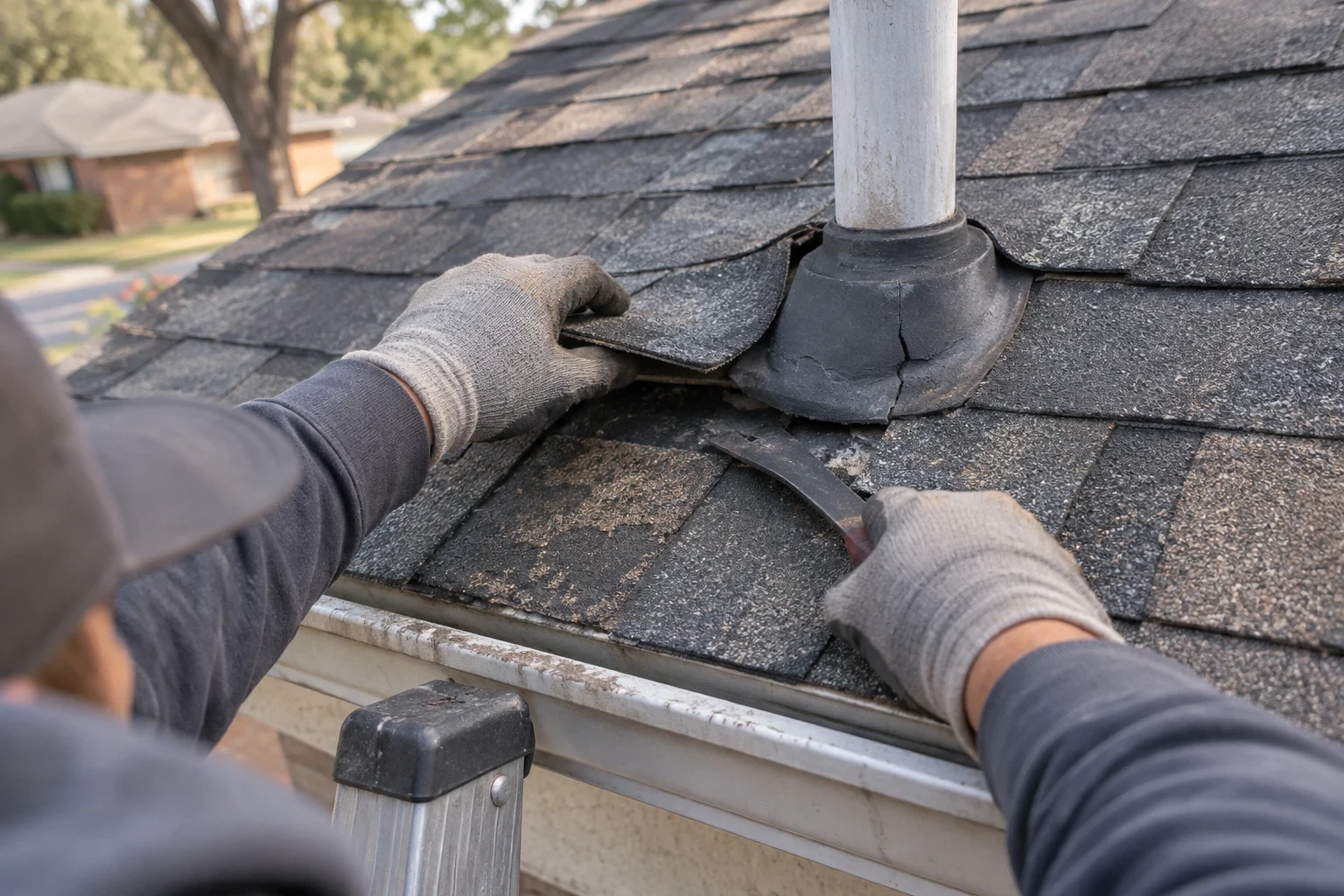
- Cracked pipe boots. Plumbing vents pass through the roof inside a rubber collar. Neoprene boots tend to crack in the sun well before the shingles around them wear out, and the leak runs down the pipe into the attic where nobody sees it.
- Poor attic ventilation. Without balanced intake at the soffits and exhaust at the ridge, attic heat cooks the shingles from underneath and moisture condenses on the decking. The result is blistered shingles, a wavy roofline and decking that softens over time.
Which problems can wait and which cannot
Not every defect needs work this month. A few missing granules on a roof with plenty of life left is something to watch and budget for. A cracked pipe boot or a lifted flashing seam is different, because water is already getting past the roof and into insulation, decking or drywall.
We sort what we find into three groups when we give an estimate: active water entry, wear that will turn into water entry within a season or two, and normal aging you can plan around. That way you know what belongs in this year's budget and what can be set aside for later.
Soft spots underfoot, daylight through the decking from the attic, or dark staining around a vent are signs the problem has already moved past the shingles. Those are the ones not to put off.
How north Texas weather speeds these problems up
Spring hail is the biggest single cause of sudden roof wear here. One storm can bruise every slope at once, and the damage often shows up as granule loss and cracking a year or two later rather than right away.
Long summer stretches of high heat do slower work. Attic temperatures climb well above the outdoor air when ventilation is short, and that heat dries out shingle asphalt and rubber boots faster. The occasional winter ice event adds stress at the eaves and flashing. Planning around the seasons helps: late fall and winter are often easier times to schedule work than the weeks right after a spring hailstorm, when demand jumps.
How to budget for roofing work before it turns urgent
The cheapest roof problem is one you schedule. Once water has soaked insulation and stained a ceiling, the job grows to include interior cleanup and sometimes decking, and you lose the choice of when it happens.
A few habits make the cost predictable. Keep a note of your roof's age and the shingle type. Look at the roof from the ground after every major hailstorm and after summer ends. Check the attic once a year with a flashlight for stains, damp insulation or light coming through. When we look at your home, we photograph what we find so you can compare it with what you see next year.
What moves the price of any roofing work is fairly consistent: the roof's size and pitch, how many penetrations and walls it has, the condition of the decking underneath, the material you choose and whether a permit is needed. Knowing those factors ahead of time lets you set money aside in steps instead of all at once.
- Write down the roof's age and shingle type now.
- Walk the property after hail and photograph anything odd.
- Check the attic each year for stains and damp insulation.
- Ask for a written, line-item estimate so you can phase the work.
More questions about common roof problems
Something not covered here? (940) 289-8182
How long do asphalt shingles usually last in this area?
It depends on the shingle grade, the attic ventilation and how many hailstorms the roof has taken. Heat and hail shorten service life, so the age on the paperwork is only a starting point.
Can I spot hail damage from the ground?
Sometimes. Dented metal vents, dinged downspouts and granules scattered near the foundation are good clues, but bruised shingles usually need a close look on the roof itself.
Does a single leak mean I need a whole new roof?
Not always. A leak from one cracked pipe boot or a loose flashing seam is a localized problem, while widespread granule loss and curling across every slope point to a roof near the end of its life.
Do you work outside Shady Shores?
Yes. We also work with homeowners in Corinth, Lake Dallas, Hickory Creek, Highland Village and the surrounding area.
Plan your roof work before the next storm season
Call and we will set up a time to look at your roof, explain which of these problems we find and what each one means, and give you a free estimate in writing so you can budget with real numbers.